
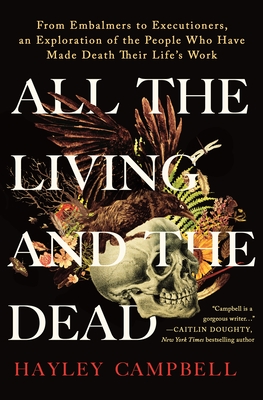
The awful truth is that we all are going to die, even how masked the event is from our society. It would be fun to cheat death and trot around here for the eternity to come as young as we like. But even as I watch the arms that are now strong, I can see the effects of my cells giving out and my flesh not being as young as it was eighteen years ago. And here is this book that takes the veil away from dying, looking into all of those who deal with death in our societies. The undertakers, the midwives, the cops, the executioners, the medical professionals, and the embalmers, to name a few. They know what death means. They see it every day in their work.
The book is a personal narrative about death and how the author experienced the process of discovering how death is met in our modern societies. Hayley Campbell grew up with the images of death and experienced losing a friend at an early age. She recounts all those events in the book, along with how it felt to dress the dead or be part of an embalming process. She beautifully mixes her personal experience with information and her observations of the death workers, the process of dying, and the images of death. Some chapters were more compelling than others; they had more depth, either with a stronger need to discover the process or a strong emotional connection to the events witnessed. Altogether, the little chapters just scratched the surface of the death industry, giving the reader a glimpse of all those jobs. Occasionally, the fine balance between the personal experience and recount of the events is lost, and the author gets caught in her ego, especially at the end when she draws everything together. However, that’s only expected as death touches the ego and the person a lot. But it did annoy me at times. I’m not sure why. Maybe it was how the author brought themselves to the center of the stage instead of the dead or the professionals. It’s not an easy balance to keep in a book like this.
I have always been fascinated with death. I wrote my first-ever essay about Finnish burial practices at the university. I have read books about the subject. This book, compared to them, was a nice addition to how it looks into the professions dealing with death. Still, I recommend Stiff by Mary Rouch if you want to understand what happens to the body without the personal that comes with this book. Racing the Clock by Bernd Heinrich handles the personal side of facing dying so beautifully. Will My Cat Eat My Eyeballs? by Caitlin Doughty handles the peculiarity of death in her book better than anything I have seen with the odd questions she dares to ask and has received as a mortician. Then, there are all the great philosophical books that handle the question of one’s mortality and what it means to exist. Compared to them, this book is too thin at times. It is as if it doesn’t dare to take a dive deeper than the dead flesh and the images the author faces. I might be too harsh, my suffering clouding my judgment.
Now, to my experience reading this book. I recommend you stop reading this review here if you want to avoid the personal I ironically criticized the author for doing. What I write next handles my personal experience of seeing my father’s dead body and how it affected the reading process. I’m not sure if it was a good idea for me to read the book now. Ever since my father died (Christmas 2023), I have been consumed by the fear of dying and the enormous pain of my father not being here, both wrapped inside me like this ball that refuses to budge. So when I read the book, there were times I had to put it down and cry as the images of my father, on the mortuary’s slab and inside the coffin with the process of decomposing having started, flooded out. I still can remember how the coldness crept in and stayed with me for days after touching my father’s fridge-cold body. The author stated in the book that it would be a good thing if we experienced dead bodies before we have to witness our loved ones, and she adds that it’s a personal choice every one of us has to make if to see our loved one’s corpses or not. There is no saying how it affects. I’m not sure yet if it was a good thing or not to see my father like that. The image stays with you. When I think of him, I see him like he was there under the covers, all frozen and blue, rather than when he was alive. Maybe that is something that will pass with time; who knows? But I don’t regret it. Yet, I agree with the book’s notion that we should see death, unlike in movies and television. Those images are unreal, impersonal, and removed from the reality. (Who knows, maybe our leaders and we all would consider mortality differently and make better decisions if we went annually to dress the dead.)
I’m still not sure if it was a good thing for me to read the book or not, still being so raw. It didn’t ease my pain. It didn’t take the fear of stopping existing away. It made more real the fact that the body we are in is flesh that will someday give out. Nevertheless, the book brings up an important subject hidden from so many of us. It shouldn’t be hidden. We are not immortal, and we cannot keep behaving like we are. I admire how Hayley Campbell dared to do all that she did to be able to write this book.
Thank you for reading the review! Have a beautiful day ❤
 K.A. Ashcomb
0 comments on “Book Review: All the Living and the Dead by Hayley Campbell”