
Metal
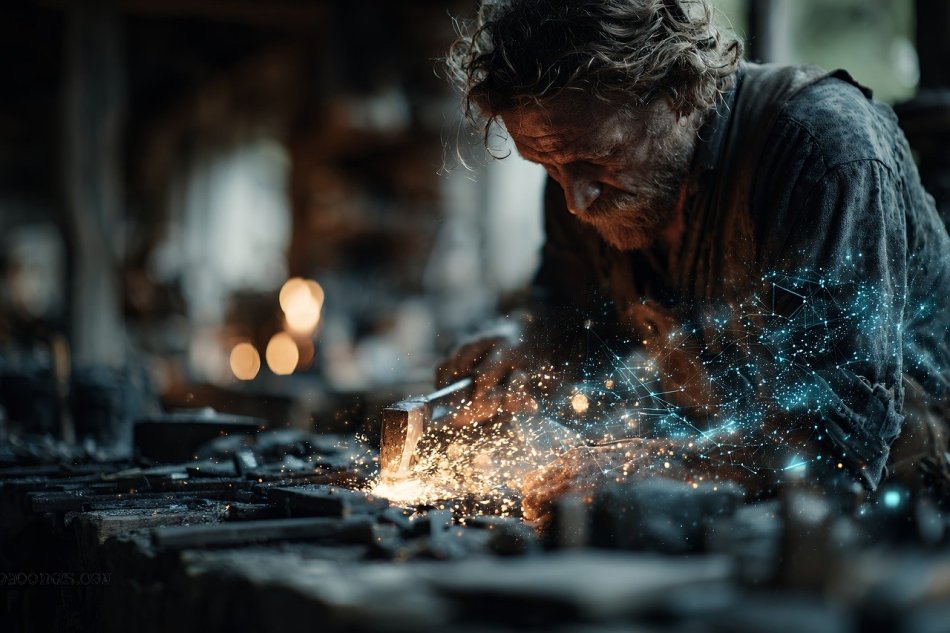
The hammer came down. The blow ricocheted through his forearm to his biceps and chest. He made the hammer come down once again, and with careful strokes, the metal turned into a blade. His whole body felt sore from the work. When the night came, all he could do was eat and watch the stars shine over his forge.
The always-burning fire at the forge kept the porch warm despite the cold of the night. The town behind him was fully asleep, and there was no single soul awake. His children and wife were fully asleep upstairs in the forge. His children had been playing all day outside with their toy swords and horses. At the end of the day, they had come in and asked their endless questions about the world.
Life was better than he could have ever dreamed it to be. He had made something of himself, so much so that he had been able to give a life to his family. A life worth living. Both his children had a future. He would make them strong, him and her. They would know love and kindness. Unlike he had had when he was their age. He had been sure to die on the battlefield, forgotten and faceless. They would never see such horrors. He swore by that.
The night stirred in front of him. He could feel the shift. It was a shift he had felt years ago. He tightened his grip on the armrest of the porch chair. He glanced up to see the iron horse’s shoes above him and then returned his gaze into the night.
He saw the shadow. It stood there, cloaked and hooded. The narrow, bony fingers stretched from its sleeves.
“What do you want, beast?” he asked.
There came a clear laughter, the sweet kind. The one he heard in his daughter’s laugh, when the sun warmed her toes, and the breeze cuddled her. A laugh he had forced himself to love. A laugh that once sent shudders down his spine, as it did now.
“That’s not a way to greet a friend, Matthew.” The words were sung out.
“You are no friend. You were banished, and you shouldn’t be here.”
The fairy stepped into the light, dropping his hood. The scar he had given to the fairy went across his face. The fairy kept his distance from the iron, unable to step onto the porch. “But the boundaries have dropped, and I wanted to see my old friend.” The smile was huge, making the scar wrinkle the otherwise smooth skin.
They would need all the iron they could get to keep the fairies away.
“But don’t worry. I’m not here to kill your sweet wife and children. No, I came to warn you. I need you to be ready, or it won’t be fun at all.” The fairy drew the hood back on and took a step back. And it was as if it had never been there.
He heard the sounds of bells in the distance, and he knew a family had died, and the wars were back.
Timid
A timid person by nature is forced to be aggressive. I skipped this one because I gave so much to the first prompt.
Ironing Clothes
A detailed description of using iron. I skipped this one too for the same reason.
The prompts are from the book A Year of Creative Writing Prompts.
It’s strange how you can never really tell what the day will be like when you wake up. Sometimes you feel you can write the greatest novel there is, and yet when you get to the computer, the feeling is gone, and all there is is doubt and words that escape you. Then there are the quiet, normal days on which you can write decent enough text. Then there are the days that words flow, and everything feels great. There doesn’t seem to be consistency to it. Sometimes a bad night’s sleep affects the writing, and other times the brief sleep is the best that could have happened to your creativity.
It might be called moody by some. But I prefer the flexibility of the mind. Without flexibility, there is no creation. And that is what we get wrong with our artificial intelligence stuff. Repetition and pattern recognition are not intelligence; what the AI needs is flexibility of thought. So I propose we need to make our AIs moody as fuck, and let’s see what happens then. But I wonder if we are intelligent enough to understand what the whole moodiness is composed of.
Thank you for reading ❤ Have a wonderful day!
 K.A. Ashcomb
0 comments on “Day 293 Writing Short Stories”